
Menu
X
- No products in the list

Key Specifications
Connection Type
Frequency Max
Connector 1
Connector 2
Body Style
VSWR Max
Insertion Loss
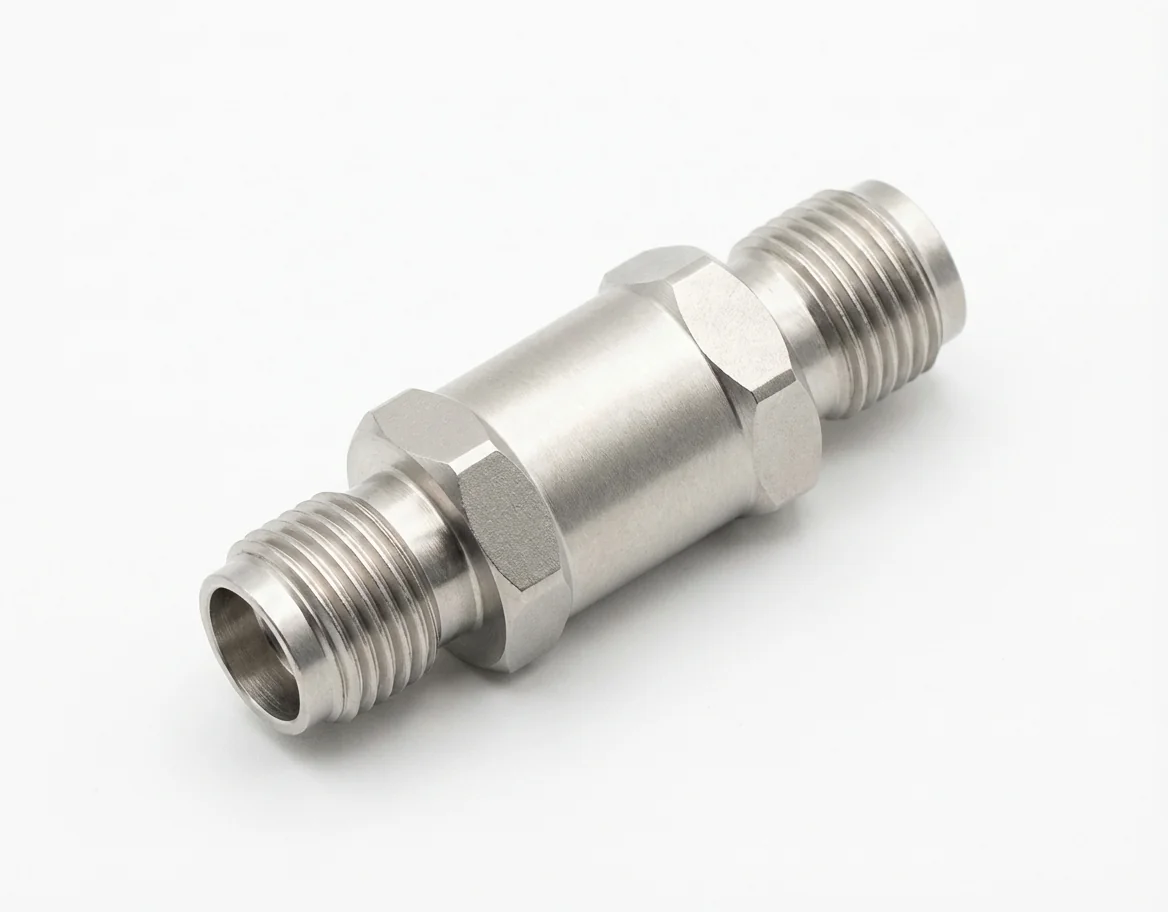
3.5mm Female to 3.5mm Female RF Adapter – 3.5/3.5-KK is engineered to provide a high-performance connection between two 3.5mm female interfaces in millimeter-wave and high-frequency test environments. This straight adapter delivers outstanding signal integrity for modular systems requiring precise interconnection between precision-grade coaxial components.
Operating up to 34 GHz with a stable 50-ohm impedance, the 3.5mm Female to 3.5mm Female RF Adapter is well-suited for advanced applications such as component performance evaluation, controlled lab testing environments, and VNA calibration and high-frequency test fixtures. This 3.5mm in-series adapter serves as a reliable interface in setups requiring repeatable, low-loss connections between high-frequency modules or cables.
This 3.5mm female to female straight adapter guarantees excellent electrical performance with a maximum VSWR of ≤1.06 and insertion loss ≤0.2 dB across the specified range. The 3.5mm Female to 3.5mm Female RF Adapter ensures minimal reflection and high signal fidelity, making it ideal for both bench testing and production validation scenarios.
Built with a passivated stainless steel body and gold-plated beryllium copper contacts, the 3.5mm in-series RF adapter provides superior durability and stable electrical contact over numerous mating cycles. This coaxial adapter supports a broad temperature range of -55°C to +165°C, maintaining performance even under challenging conditions.
Fully compliant with RoHS and REACH directives, this 3.5mm Female to 3.5mm Female RF Adapter is designed for environmentally responsible integration into telecommunications, defense, and aerospace systems. Custom configurations of the 3.5/3.5-KK1 coaxial adapter can be developed upon request to accommodate specific system requirements in high-reliability RF networks.