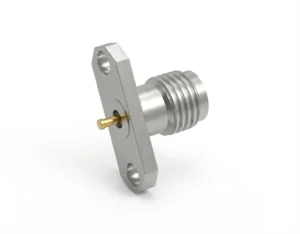
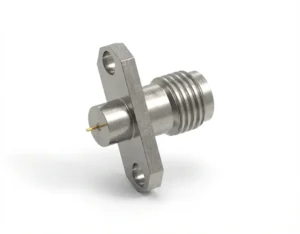
2.92mm Female 2-Hole Flange Mount Field-Replaceable RF Connector – Model 2.92-KFD17
The 2.92 mm female 2-hole flange mount RF connector with a 0.30 mm pin and 12.22 mm hole spacing delivers excellent signal fidelity and mechanical strength for broadband RF applications up to 40 GHz. This field-replaceable connector offers reliable electrical stability in repeated test cycles.
Electrical Performance
Achieving VSWR ≤ 1.15 and insertion loss ≤ 0.06 √F(GHz) dB, the 2.92 mm female 2-hole flange mount RF connector ensures low-loss transmission and phase accuracy. The 0.30 mm pin design balances contact robustness with fine alignment.
Materials and Compliance
Crafted from stainless steel and gold-plated beryllium copper, the 2.92 mm female flange connector provides outstanding durability and meets full REACH and RoHS standards.
Applications
Used in modular analyzers, signal distribution panels, and 2-hole flange mount RF assemblies where space optimization and mechanical precision are essential.
Male Equivalent
Pair with the 2.92 mm male 2-hole flange mount RF connector – Model 2.92-JFD17. See the complete 2.92 mm RF connector series in our RF Connector Catalog.