
Menu
X
- No products in the list

Key Specifications
Connection Type
Frequency Max
Connector 1
Connector 2
Body Style
VSWR Max
Insertion Loss
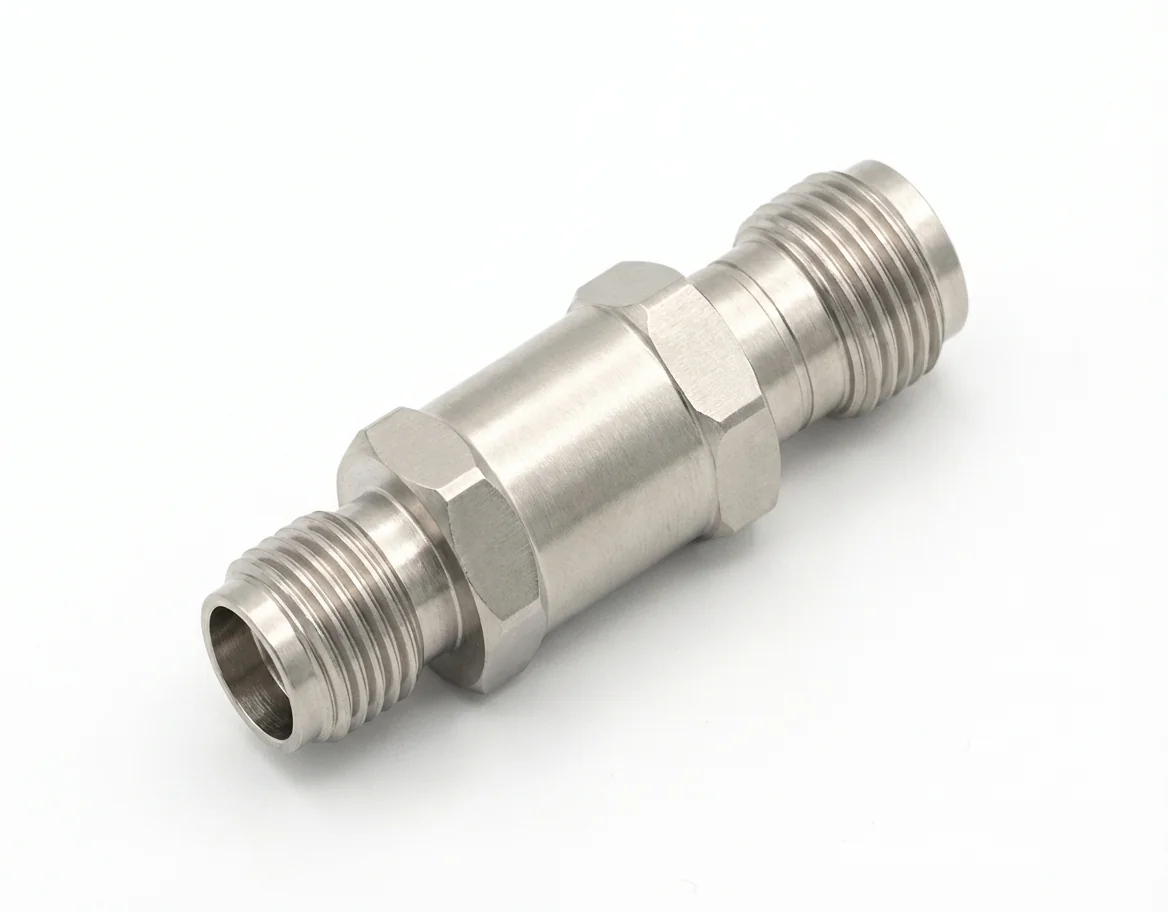
The 3.5mm Female to 2.4mm Female RF Adapter – 3.5/2.4-KK1, also referred to as 2.4mm Female to 3.5mm Female RF Adapter – 2.4/3.5-KK1, is a high-frequency coaxial adapter designed for seamless interconnection between 3.5mm and 2.4mm female interfaces. This straight adapter enables backward compatibility between precision metrology-grade connectors and robust RF test setups.
With a frequency range reaching up to 26.5 GHz and a controlled 50-ohm impedance, the 3.5mm Female to 2.4mm Female RF Adapter provides reliable signal integrity for precision lab environments, modular test fixtures, and broadband communications modules. This 3.5mm adapter is commonly used in applications such as component performance evaluation, end-of-line quality verification, and 5G interface validation.
This 3.5mm between-series RF adapter achieves excellent RF performance with a typical VSWR of ≤1.12 and an insertion loss of ≤0.25 dB, ensuring minimal signal degradation and optimal return loss across its operating range. This straight coaxial adapter is especially useful for engineers integrating legacy 3.5mm systems with modern 2.4mm instrumentation.
The 3.5/2.4-KK1 female to female adapter is manufactured from passivated stainless steel with gold-plated beryllium copper contacts to provide exceptional corrosion resistance and long-term durability. This coaxial adapter performs reliably over a temperature range from -55°C to +165°C, ensuring stable operation under a variety of environmental conditions.
Fully compliant with RoHS and REACH regulations, the 3.5mm Female to 2.4mm Female RF Adapter is ideal for advanced RF testing, telecom modules, aerospace electronics, and industrial RF applications. Custom versions of this 3.5mm female adapter can be provided on request to accommodate unique integration or mechanical requirements.