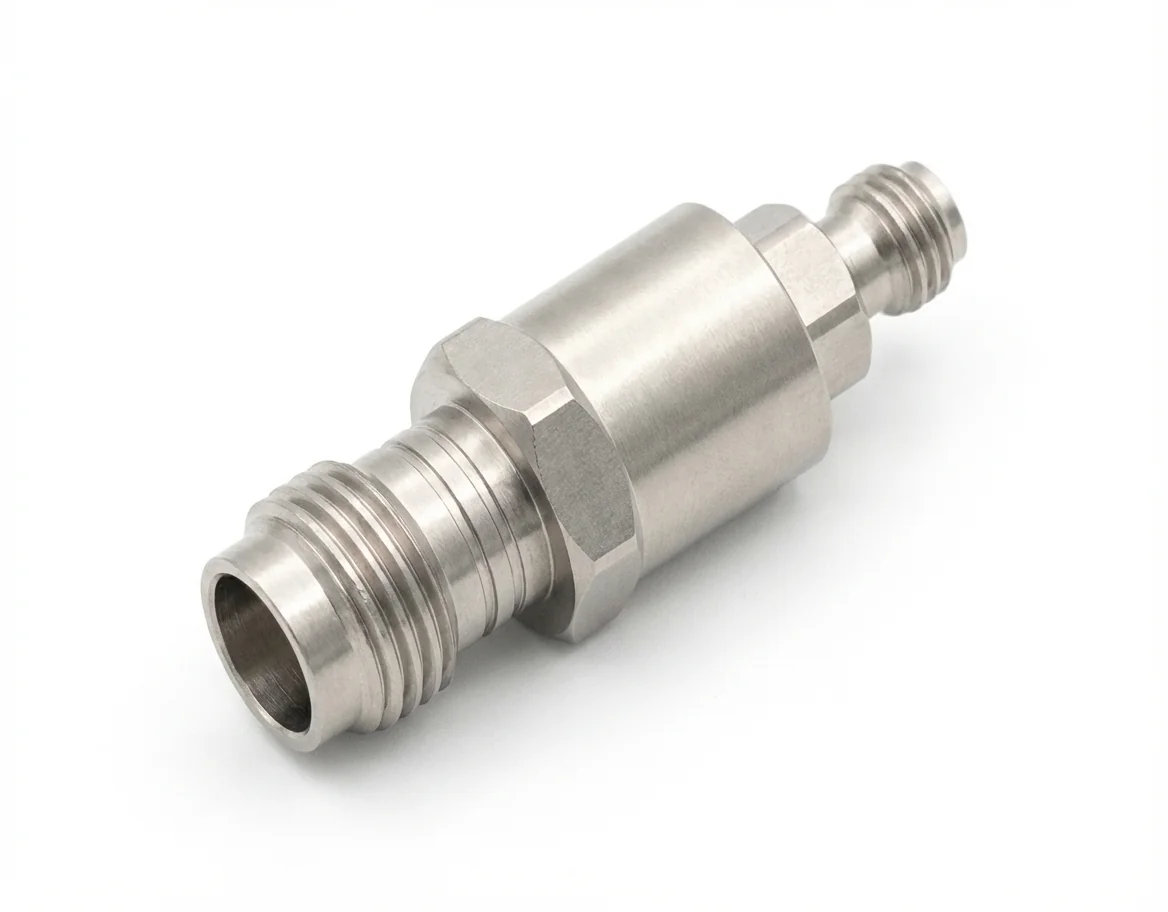
The 1.85mm Female to 1.0mm Female RF Adapter 1.85/1.0-KK1 – also referred to as 1.0mm Female to 1.85mm Female Adapter 1.0/1.85-KK1 – is a precision between-series adapter engineered to support signal transitions up to 67 GHz. This adapter enables direct interconnection between 1.85mm and 1.0mm interfaces, ensuring minimal signal degradation and stable mechanical mating in high-frequency RF systems.
The 1.85/1.0-KK1 RF Adapter is ideally suited for applications requiring ultra-low-loss signal transmission and reliable impedance matching in densely packed RF environments. It is especially beneficial in environments such as component performance evaluation, where precise phase stability and signal clarity are mission-critical. Furthermore, this adapter plays a pivotal role in RF connectivity for 5G antenna systems, helping engineers bridge measurement setups involving non-standardized connector pairings. In addition, it offers value in medical device RF interfaces, where compact, low-loss RF pathways are essential.
Built with a rugged stainless steel body and gold-plated beryllium copper contacts, the 1.85mm Female to 1.0mm Female RF Adapter guarantees repeatable performance across thousands of mating cycles. Its insertion loss is specified at ≤0.25 dB, with a VSWR below 1.25:1 across the operational bandwidth, ensuring superior return loss and minimal signal reflection. Its straight geometry minimizes the adapter footprint and supports tight layout integration.
This 1.85mm Female to Female coaxial Adapter operates reliably from -55°C to +165°C, making it compatible with harsh test environments, aerospace conditions, and advanced radar systems. All Mechanc adapters, including the 1.85/1.0-KK1, conform to international compliance directives (RoHS, REACH) and are supported by dimensional drawings and test reports upon request.
With its broadband capability and reliable mechanical structure, the 1.85mm Female to 1.0mm Female RF Adapter 1.85/1.0-KK1 is a strategic addition to any high-frequency RF engineer’s toolkit, supporting seamless interoperability between advanced test setups and system modules.