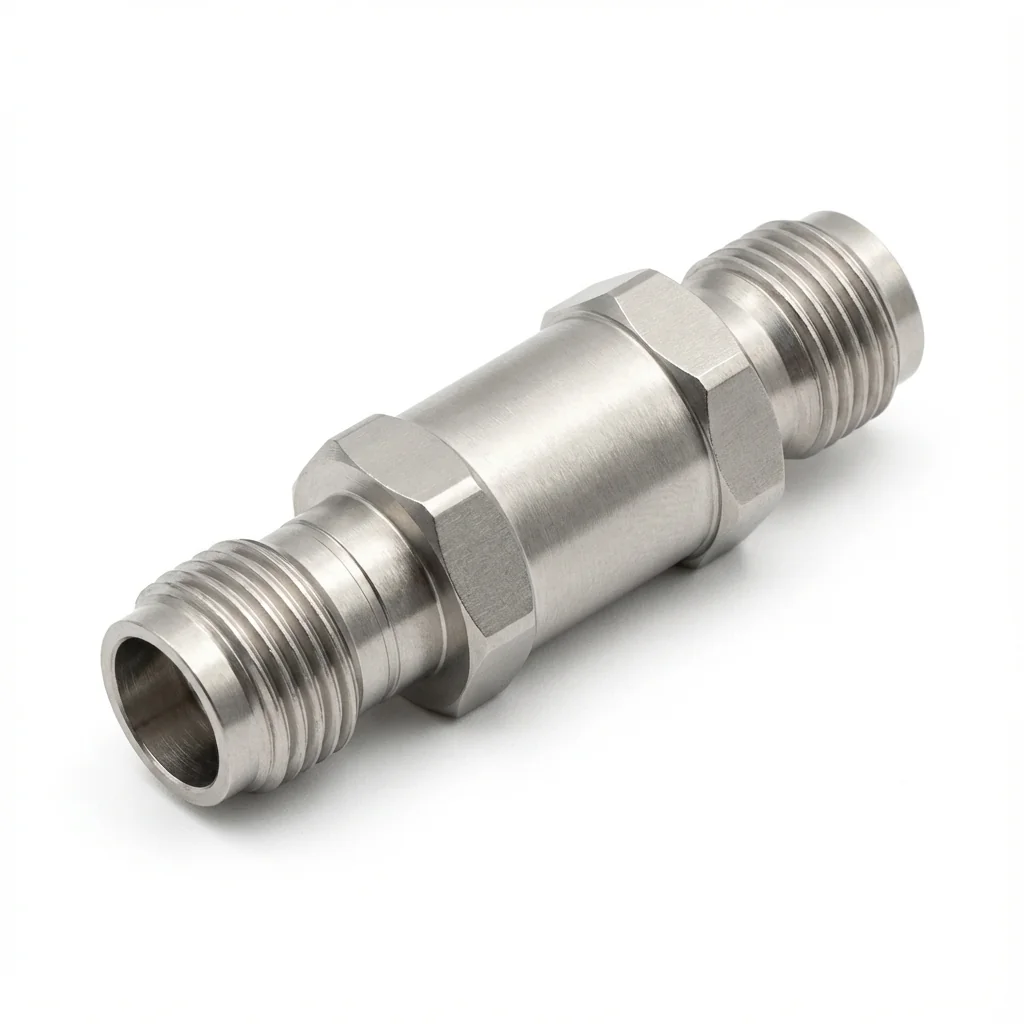
The 2.4mm Female to 2.92mm Female RF Adapter – 2.4/2.92-KK1, also referred to as 2.92mm Female to 2.4mm Female RF Adapter – 2.92/2.4-KK1, is a precision coaxial adapter engineered to bridge modern 2.4mm and legacy 2.92mm female interfaces. Designed for high-frequency operation and long-term mechanical stability, this straight-body adapter ensures seamless interconnection in mixed-connector systems without compromising signal integrity.
Supporting a wide frequency range up to 40 GHz and a nominal 50 Ω impedance, the 2.4mm Female to 2.92mm Female RF Adapter is optimized for mid-to-high-frequency signal transmission, RF module testing, and microwave interconnection in aerospace, industrial, and telecommunication systems. It is particularly useful for applications such as end-of-line quality verification, automotive radar validation, and LEO payload RF interconnects.
The 2.4mm Female to 2.92mm Female RF Adapter features excellent electrical characteristics, including insertion loss ≤0.35 dB and VSWR ≤1.12 at 40 GHz. These parameters ensure high return loss performance and stable signal flow in sensitive measurement environments and signal-critical subsystems.
Manufactured from high-grade passivated stainless steel and gold-plated beryllium copper contacts, this 2.4mm between-series adapter is designed for mechanical durability and minimal contact resistance. It performs reliably across a wide temperature range of -55°C to +165°C, suitable for both laboratory test benches and rugged field environments.
RoHS and REACH compliant, Mechanc’s 2.4mm Female to 2.92mm Female RF Adapter delivers a cost-effective and high-performance solution for engineers working across hybrid connector platforms. Custom options are available upon request to support unique system configurations and integration needs.