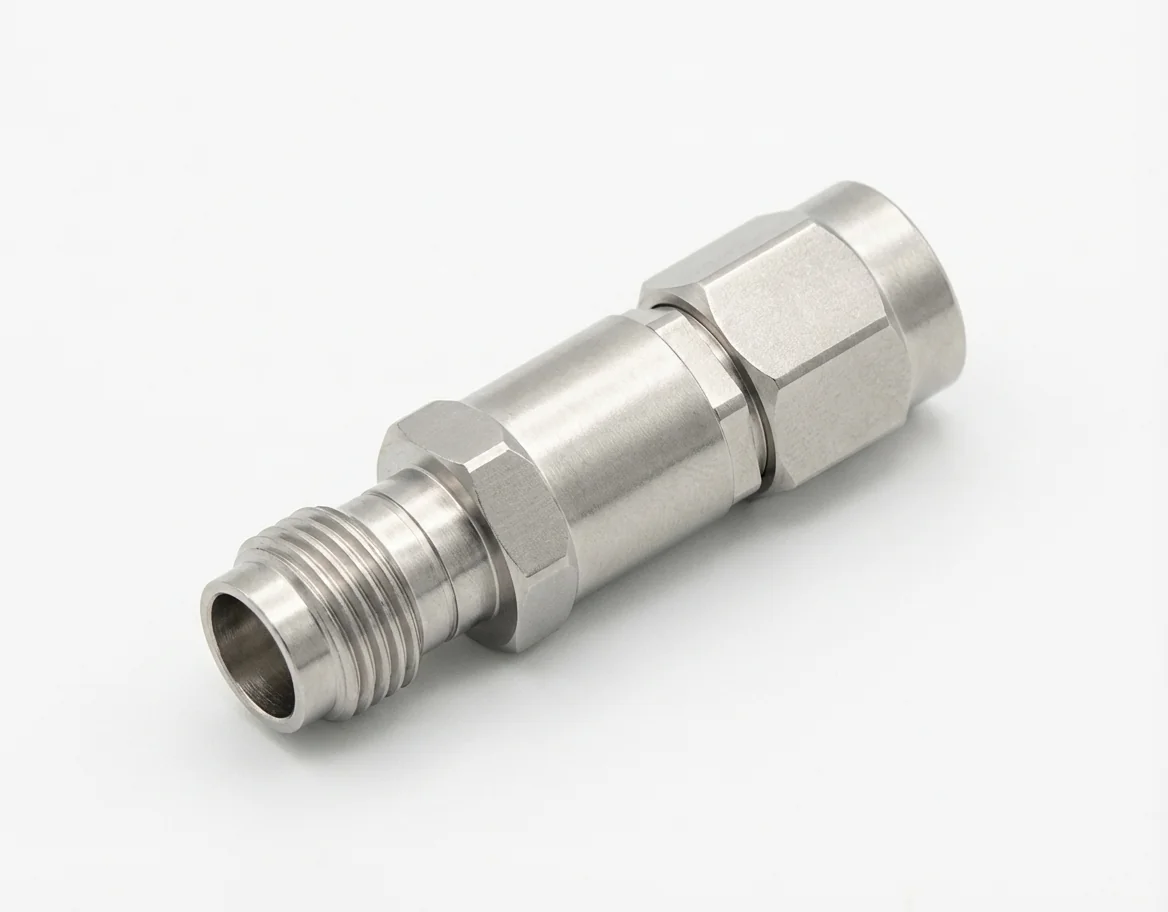
The 2.4mm Female to SMA Male RF Adapter – 2.4/SMA-KJ1, also referred to as SMA Male to 2.4mm Female RF Adapter – SMA/2.4-KJ1, is a precision-engineered coaxial adapter designed to transition between high-frequency 2.4mm components and widely used SMA male interfaces. This 2.4mm straight adapter enables engineers and test professionals to connect precision-grade systems with legacy infrastructure while maintaining excellent electrical integrity and minimal loss.
With a frequency range up to 26.5 GHz and a characteristic impedance of 50 ohms, the 2.4mm Female to SMA Male RF Adapter is ideal for mixed-connector testing environments. It is especially suited for integration into controlled lab testing setups, satellite system evaluations, and microwave backhaul links where compatibility and reliability are key.
This 2.4mm between-series coaxial adapter offers outstanding RF performance, with an insertion loss ≤0.25 dB and VSWR ≤1.20 across its operating range. The 2.4mm Female to SMA Male RF Adapter minimizes signal degradation in high-frequency applications while ensuring repeatable, low-resistance connections for measurement accuracy and system consistency.
Built from passivated stainless steel with gold-plated beryllium copper contacts, the 2.4mm Female to SMA Male RF Adapter is designed for long-term mechanical durability and stable performance under frequent mating cycles. It operates within a temperature range of -55°C to +165°C, making it suitable for demanding aerospace, defense, and telecom use cases.
Fully compliant with RoHS and REACH regulations, this 2.4mm to 3.5mm adapter exemplifies Mechanc’s commitment to sustainability and quality. The 2.4mm Female to SMA Male RF Adapter – 2.4/SMA-KJ1 – is available with custom configurations to meet specialized interconnection needs across test and mission-critical systems.