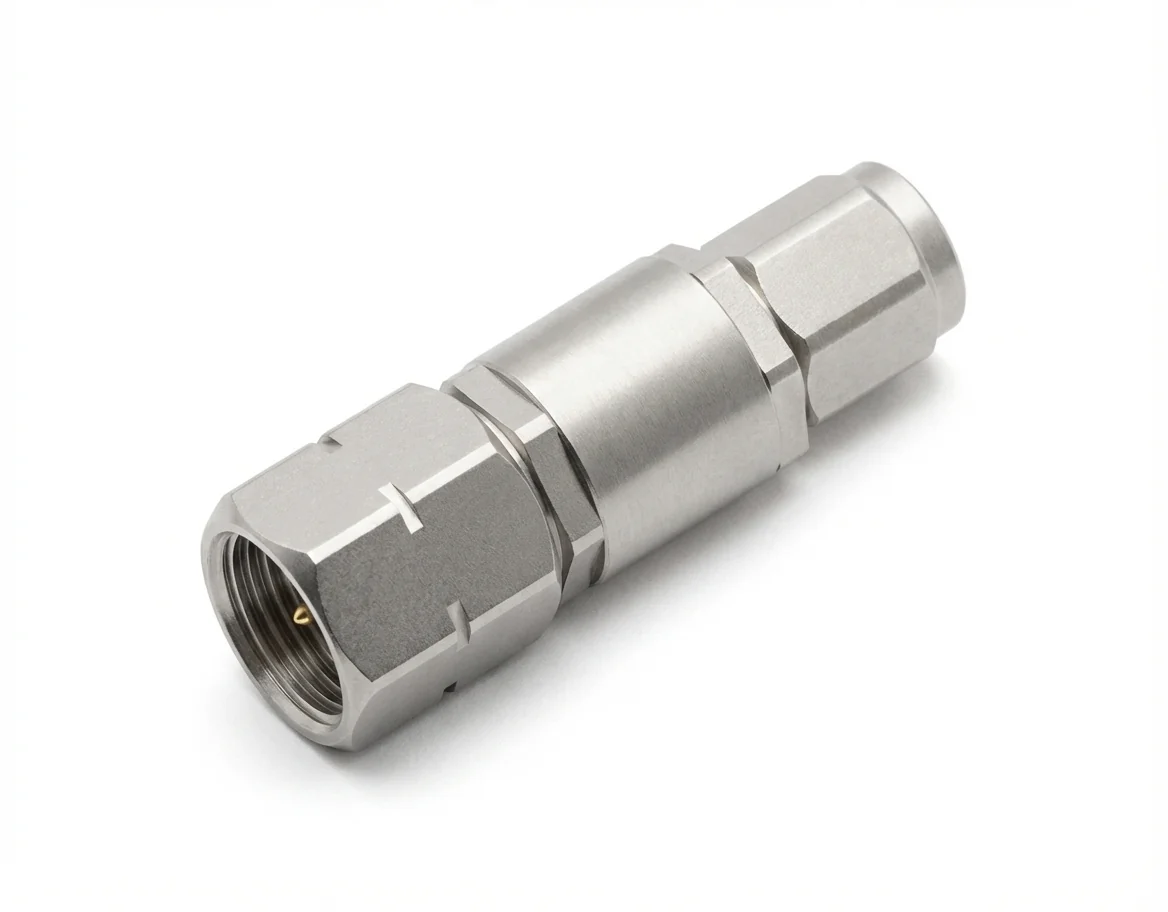
The 2.4mm Male to 1.0mm Male RF Adapter – 2.4/1.0-JJ1, also referred to as 1.0mm Male to 2.4mm Male RF Adapter – 1.0/2.4-JJ1, is an ultra high-frequency coaxial adapter designed to connect 2.4mm male and 1.0mm male interfaces in a straight configuration. Engineered for maximum precision and minimal signal degradation, this adapter enables secure and reliable transitions between components in compact and high-frequency RF systems.
Capable of operating up to 50 GHz with a stable 50 Ω impedance, the 2.4mm Male to 1.0mm Male RF Adapter is ideal for mmWave signal testing, RF module calibration, and high-frequency transmission in advanced telecom and aerospace platforms. Its compact form factor and robust interface are particularly suited for integration into 5G antenna systems, combat aircraft RF systems, and VNA calibration environments.
Delivering VSWR ≤1.2 and insertion loss ≤0.7 dB at 50 GHz, this 2.4mm between-series RF adapter maintains high signal integrity even in the most frequency-sensitive applications. Its outstanding electrical performance makes it an indispensable component in precision labs and testing setups requiring reliable mmWave performance.
The 2.4mm Male to 1.0mm Male RF Adapter is built from rugged passivated stainless steel with gold-plated beryllium copper contacts, ensuring mechanical durability and low contact resistance. It performs consistently across a broad temperature range of -55°C to +165°C, making it suitable for both field deployment and controlled testing environments.
Fully compliant with RoHS and REACH regulations, the 2.4mm Male to 1.0mm Male RF Adapter reflects Mechanc’s commitment to delivering environmentally responsible and high-performance RF components. Custom versions are available to meet specific system integration and frequency compatibility requirements.