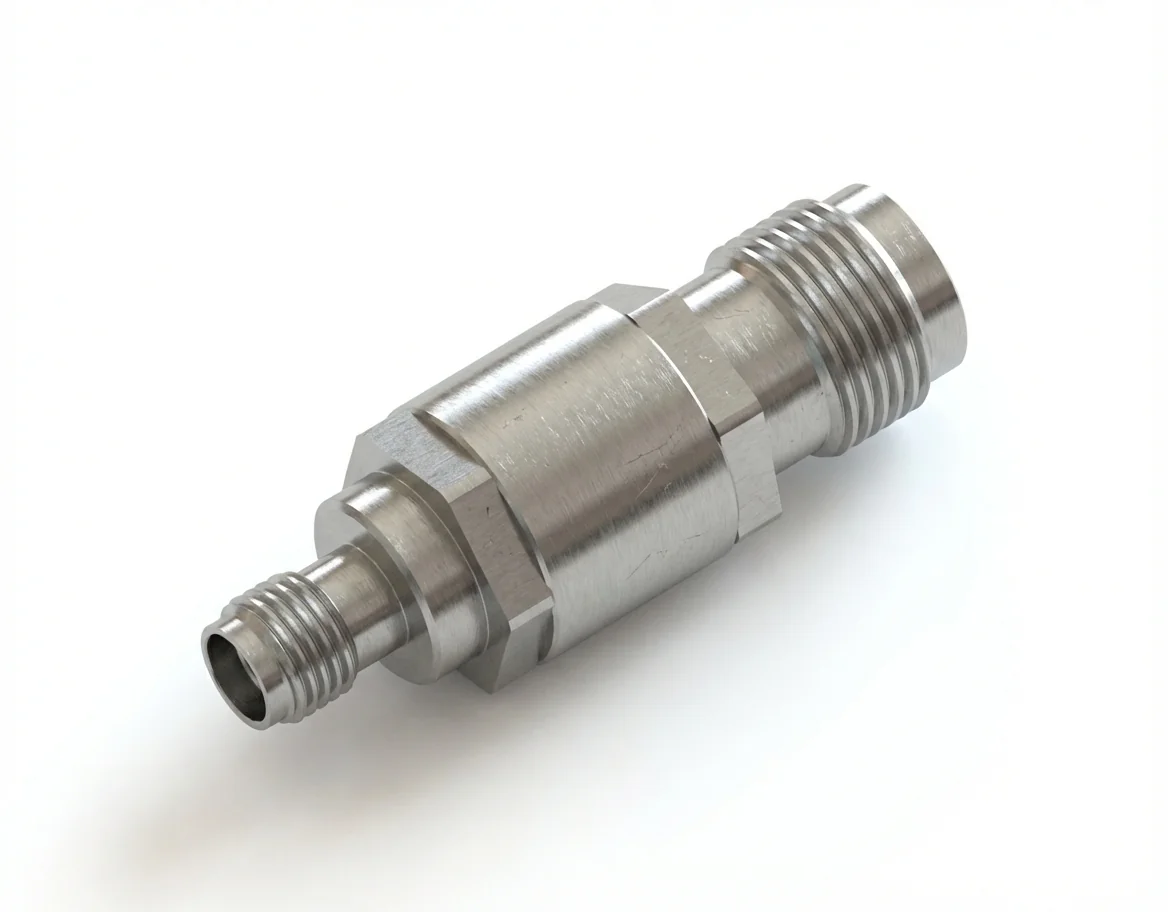
The SMA Female to TNCA Female RF Adapter – SMA/TNCA-KK1, also referred to as TNCA Female to SMA Female RF Adapter – TNCA/SMA-KK1, is a precision coaxial adapter designed to connect standard SMA female interfaces to TNCA female connectors. This straight adapter ensures stable performance in applications requiring secure transitions between compact SMA components and robust TNCA configurations.
Operating efficiently up to 18 GHz with a 50-ohm impedance, the SMA Female to TNCA Female RF Adapter is ideal for use in rugged RF communication networks, satellite payload systems, and defense-grade radio equipment. This SMA between-series adapter supports dependable signal transmission in RF environments requiring high durability and compatibility, such as satellite communication links, defense RF electronics, and end-of-line testing environments.
Engineered with a low VSWR of ≤1.15 and insertion loss of ≤0.25 dB, the SMA Female to TNCA Female RF Adapter maintains signal integrity and minimizes reflections, enabling accurate results during high-frequency measurements and communications. Its secure mating design ensures reliable connections under repeated use and varying field conditions.
Constructed from passivated stainless steel with gold-plated beryllium copper contacts, this SMA to TNCA adapter offers superior mechanical strength and long-term reliability. The SMA Female to TNCA Female RF Adapter operates over a wide temperature range of -55°C to +165°C, making it suitable for deployment in both laboratory setups and harsh outdoor environments.
RoHS and REACH compliant, the SMA Female to TNCA Female RF Adapter is a trusted interconnect solution in telecom, aerospace, and defense industries. Customized variants of this SMA female coaxial adapter can be supplied on request to meet the unique mechanical or electrical needs of specific integration projects.