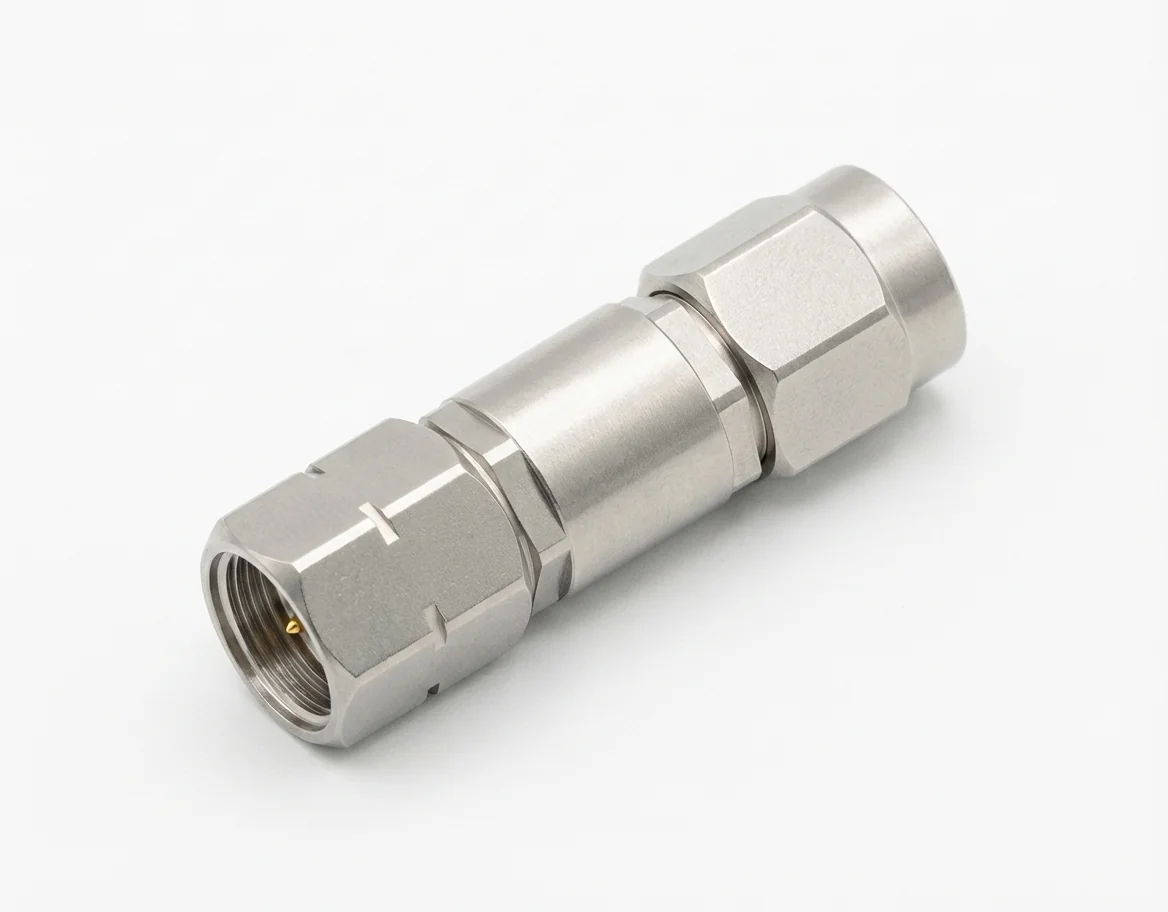
The 2.4mm Male to 2.92mm Male RF Adapter – 2.4/2.92-JJ1, also referred to as 2.92mm Male to 2.4mm Male RF Adapter – 2.92/2.4-JJ1, is a high-frequency coaxial adapter designed to connect 2.4mm and 2.92mm male interfaces with maximum signal fidelity. Its straight configuration and precision-machined body ensure stable performance in dense RF systems where compatibility and performance are critical.
Operating efficiently up to 40 GHz with a controlled 50 Ω impedance, the 2.4mm Male to 2.92mm Male RF Adapter is engineered for test labs, R&D environments, and industrial RF setups requiring seamless integration between legacy 2.92mm and high-frequency 2.4mm connectors. It is particularly useful in applications like microwave backhaul links, satellite ground qualification testing, and thermal and stress simulation testing.
The 2.4mm Male to 2.92mm Male RF Adapter delivers strong electrical performance with insertion loss ≤0.35 dB and VSWR ≤1.12 at 40 GHz, ensuring low reflection and consistent transmission in both test and live RF environments. It supports mission-critical tasks where signal integrity, phase stability, and repeatable measurements are essential.
Constructed with a durable passivated stainless steel housing and gold-plated beryllium copper contacts, the 2.4/2.92-JJ1 coaxial adapter is built to withstand high mechanical stress and thermal cycling. It operates reliably in temperature ranges from -55°C to +165°C, making it suitable for both laboratory and field deployments.
Fully RoHS and REACH compliant, Mechanc’s 2.4mm between-series adapters offers a cost-effective, high-performance interconnect solution for telecom, aerospace, and defense sectors. Custom configurations are available for clients requiring tailored performance in hybrid connector architectures.