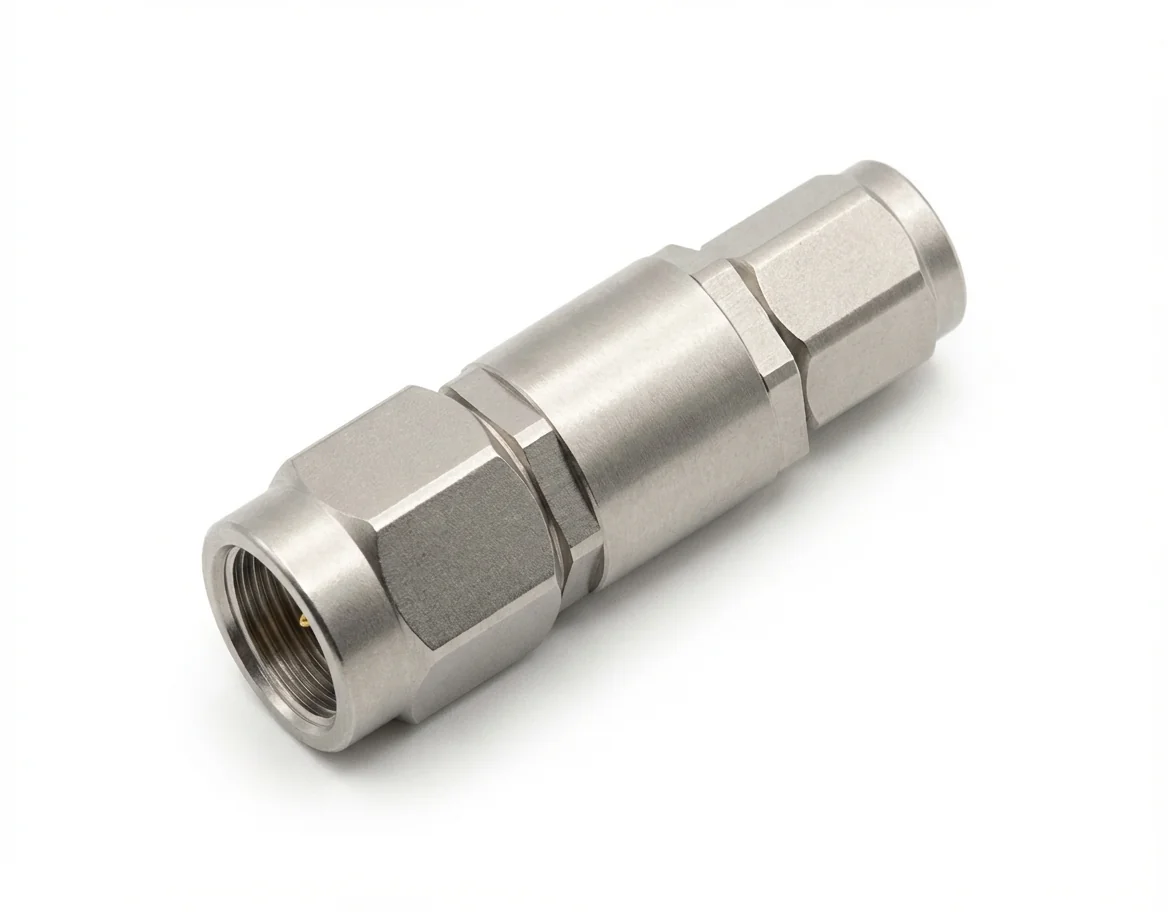
The 2.92mm Male to 1.0mm Male RF Adapter – 2.92/1.0-JJ1, also referred to as 1.0mm Male to 2.92mm Male RF Adapter – 1.0/2.92-JJ1, is a high-frequency coaxial adapter engineered for secure, low-loss interconnection between 2.92mm male and 1.0mm male interfaces. This straight adapter supports reliable signal transitions between K-type connectors and precision-grade 1.0mm ports for high-frequency test and measurement applications.
With VSWR ≤1.15 and insertion loss ≤0.5 dB, this K to 1.0mm coaxial adapter delivers excellent electrical performance for accurate signal measurement, maintaining low reflection and consistent transmission in sensitive environments. The 2.92mm Male to 1.0mm Male RF Adapter is especially suited for RF engineers requiring precise signal performance in millimeter-wave testing and microwave applications.
Constructed from passivated stainless steel with gold-plated beryllium copper contacts, this 2.92mm to 1.0mm straight adapter ensures long-term mechanical durability and consistent signal integrity across repeated mating cycles. Its robust design allows it to operate reliably from -55°C to +165°C, making it suitable for both laboratory and rugged operational conditions.
RoHS and REACH compliant, this 2.92mm between-series adapter delivers exceptional signal integrity, mechanical strength, and material reliability. Custom versions of the 2.92mm Male to 1.0mm Male RF Adapter can be provided upon request to meet the specific mechanical or electrical requirements of aerospace, defense, telecom, and advanced test environments.