
Menu
X
- No products in the list

Key Specifications
Frequency Max.
Jacket Diameter
Jacket Material
Inner Conductor Type
Phase Stability
Amplitude Stability
Attenuation @ Max Freq.
Power Resistance
Minimum Static Bend Radius
Minimum Dynamic Bend Radius
Operating Temperature Range
Description
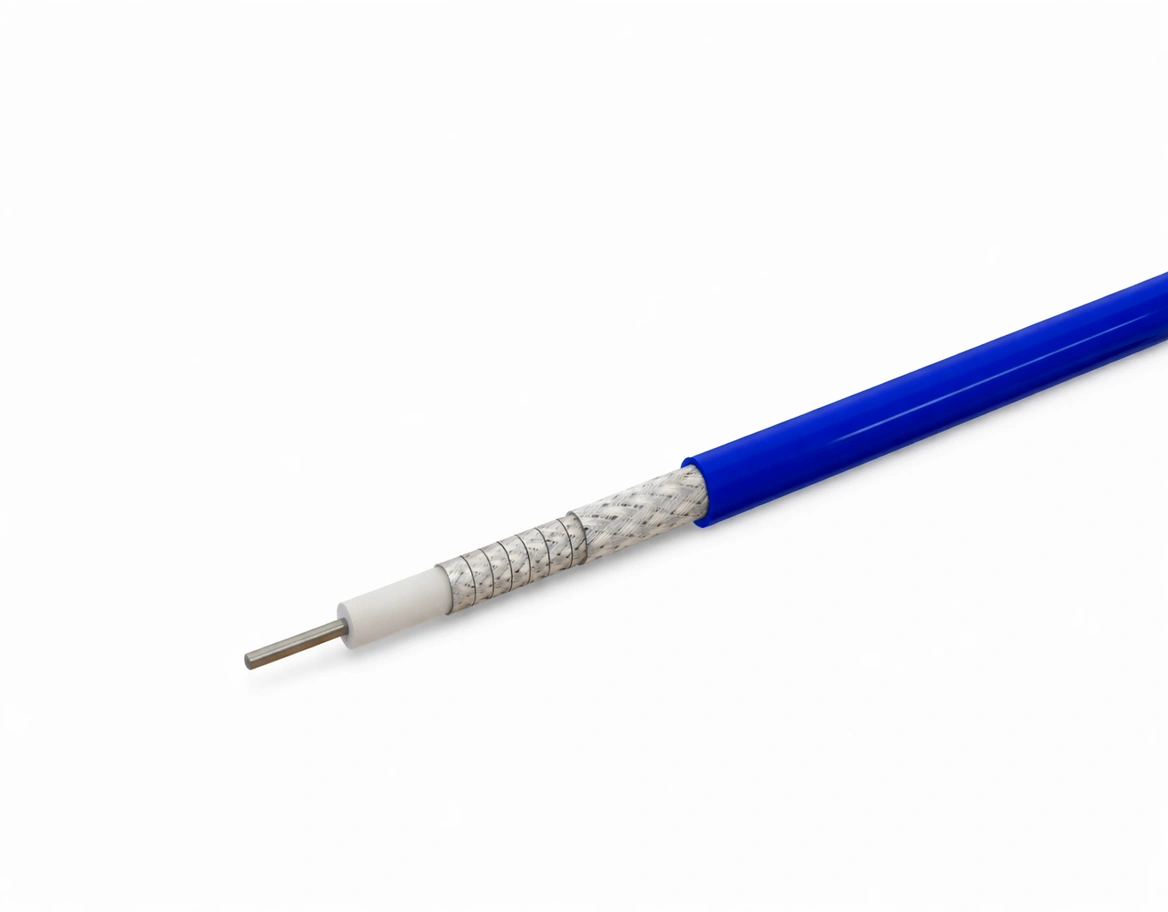
The CFE800 cost-effective low-loss coaxial cable offers a practical balance between performance and affordability for RF and microwave applications requiring consistent electrical stability. Operating up to 18 GHz with a 50 Ω impedance, it maintains phase stability ≤ ±9° @ 18 GHz and amplitude variation ≤ ±0.1 dB, providing clean and predictable signal transmission across a wide frequency range. Explore additional cost-efficient models in the CFE Series – Cost-Effective Low-Loss Coaxial Cables.
The CFE800 cable features a 2.30 mm silver-plated copper inner conductor and a low-density PTFE dielectric for low insertion loss and stable impedance. Dual shielding layers — self-adhesive aluminum foil and silver-plated copper braid — provide > 90 dB EMI suppression, while the FEP jacket ensures flexibility and chemical resistance. Attenuation values remain as low as 0.151 dB/m @ 1 GHz and 0.763 dB/m @ 18 GHz, with a velocity of propagation of 76% for accurate phase control.
With an outer diameter of 8.10 mm, single-bend radius of 40 mm, and repeated-bend radius of 81 mm, the CFE800 low-loss coaxial cable maintains excellent durability and mechanical reliability. It supports up to 2 kV DC voltage and operates from –55 °C to +125 °C, making it suitable for laboratory, communication, and general RF setups where long-term stability and cost efficiency are key. For additional low-loss cable families, visit the Low-Loss Coaxial Cable Series.
Manufactured by Mechanc Shanghai Information Technology Co., Ltd., the CFE800 cost-effective low-loss coaxial cable delivers dependable RF performance, low attenuation, and verified REACH and RoHS compliance—making it the ideal choice for engineers seeking affordable yet stable signal transmission solutions.